
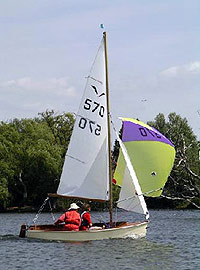
Gull sailing dinghy
The Gull dinghy was designed by Ian Proctor. The boat is easy to sail and can handle a variety of weather conditions that are likely to be encountered both inland and on the sea. For this reason they are often used for training purposes. The Gull dinghy can be comfortably sailed when two people are in them although three small persons can be accommodated in most conditions except for heavy weather. Gull dinghies may have either a wooden sparred gunter rig, metal jointed bermudian mast, or an un-jointed bermudian mast. A number of different versions have been produced as outlined below.
Wooden Mk I Gull dinghy
The Gull dinghy was originally designed as a frameless double chine dinghy (apart from the prototype) with two buoyancy tanks built in, one forward and one aft. The hull is built on a jig, producing a stiff boat and the lack of frames give a clean interior which is easy to varnish.
The cockpit is enormous for the size of boat and if you include the stern tank, which can be used as a seat, there are in fact three thwarts which is useful when the dinghy is rowed, or powered by an outboard. There are also side benches which run from the centre thwart to the rear buoyancy tank. The bottom of the hull is stiffened and there are no separate floorboards so your feet get wet if you ship any water.
The boat has a centreboard which is, in my opinion, preferable in any dinghy, and is most comfortable to sail in light and moderate winds. In rough conditions, however, the narrow gunwhale is not a particularly comfortable perch, but you can?t have everything! (Widened gunwhales are allowed by current Gull Class Association rules, and are a straightforward modification.)
Buoyancy arrangements are forward and aft tanks built into the hull, but the Gull Class Association feel that additional buoyancy bags secured under the side benches are useful to give more lift. Large hatches in the tanks make access easy for repairs such as tightening up rudder fittings, repairing the ply skin, etc., and, of course, gives you a dry storage compartment for small items.
The mast has two positions: one for mainsail and jib and one for mainsail alone. Rather than reefing, stepping the mast forward gives more cockpit room for the crew (useful for the family).
GRP Mk III Gull dinghy
The Gull Class Association made its changeover to GRP in three moves. The first GRP Gull introduced in 1976 was almost an exact replica in glass of the wooden boat, but did not sell very well largely because of its cost, so a cheaper Mk II version was later introduced which had no permanent foredeck, but a detachable PBC covered nylon effort which could be removed at will. The boat still did not sell very well and so in 1971 a new Mk III Gull was introduced. This took advantage of GRP as a material and was a round bilge hull with almost identical underwater lines to the original double chine boat, but had a flared-out hull increasing the beam by 6″. The new boat also had side decks which, of course, make her more comfortable to sit out in a blow. (It is held by many in the Class Association that the Mk III GRP hulls with sail numbers around 1900 – 2000 are about the quickest Gull dinghies made, other factors being equal.)
The buoyancy is built-in and there is only one mast position, so the jib must be used at all times and reefing achieved by taking rolls around the boom.
There is less cockpit room in the Mk III Gull and one main thwart with side benches extending to the stern. A removable aft storage box is incorporated into the design which is a good feature and allowance has been made for outboard storage at the stern.
Length : 3.35m
Beam : 1.45m
Weight : 160lb