
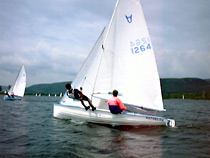
Osprey sailing dinghy
The Osprey designed Ian Proctor has stood the test of time, sailable in all but the most extreme weather conditions, whether inland reservoir, tidal rivers or mountainous seas. A well behaved and balanced boat, capable of sailing or racing with a crew of two or three, with one trapeze. She is provided with a spacious interior, with a choice of fittings and layout, rig and sails allowing competitive pricing.
It is a one Design Class rules are administered by the RYA although cosmetic improvements have occurred over the years. Old boats can still (and often do) compete at the top end of the fleet.
With a UK handicap of 938 the Osprey is a fast exciting boat to sail. The Osprey relies on the traditional values of boat design, dating back to the 1950’s, to achieve its speed. An Osprey doesn’t struggle upwind only to fly on the downhill leg, it’s simply fast all over the course.
Upwind performance is catered for by a large over-lapping Genoa, whereas off-wind speed is generated by the large spinnaker emerging from the ‘chute. (Spinnaker bags are a rare sight due to the generous freeboard provided in the original design. This makes the intake of water so minimal as to render bags an inconvenience compared to the speed of a ‘chute.)
With the ever increasing sophistication and competitiveness of many classes, competent helms and crews are finding themselves off the pace as a result of being either too heavy or light. Crew weight has never featured highly in the Osprey Class with a range of weights that any other class would find hard to beat. After all, with a hull weight of 134kg the boat itself is no lightweight. Perhaps this is the reason why the odd 7kgs or so of crew weight does not make that much difference. The extra weight and power upwind only results in a penalty downwind!
Length : 5.35m
Beam : 1.75m
Weight : 134.kg
Sail Area : 31.15m sq max
Comments
Crewed an Osprey at Stone sailing club on the Essex Blackwater during the seventies. Magnificent boat with great longitudinal stability. Single handed on trapeze a dream!
I sailed an Osprey for a couple of years at RAF Changi Yacht Club in the late 60s. One of the most exciting dinghys of it’s time single handed trapezing and great to race 2 up.
In the very early 1960’s I built and sailed an Osprey, she was from a Bell Woodworking kit and was named Shady Lady. I sailed her with my young wife at Barmouth, west Wales, but then along came family, business etc. However, yesterday, after a gap of 45 years I had the delight of helming the one club Osprey at my new local club, Club Mojacar de Vela in southern Spain and today ( apart from a few aches ) I feel young again !
Just thought you would like to know,
Sincerely,
Tony IlesMy father sailed Ospreys In New Quay, Ceredigion, in the 1960s he was 5ft 2″ and as firey as can be skippering in a race. So few of us ever wanted to crew. He needed Weight so he hunted folks from anywhere, to crew including holiday makers off the pier! On a leisure sale he was great and loved to show off the Osprey’s performance. and I loved hanging out on the trapese, skimming the sea. He rarely won races because of the Handycap and the fact that he capsized a lot with light crews!! but he loved both boats to distraction. The later boat circa 1963 lighter and frisky. now its time for me to retire and invest in some fun.
Tim