
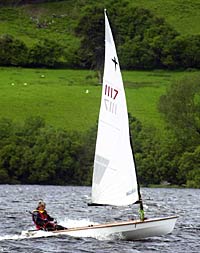
Phantom sailing dinghy
The Phantom dinghy was designed by Paul Wright and Brian Taylor in 1971. They wanted to produce a single-hander that was exciting to sail, manageable and at the same time affordable to build. It isn’t possible to design a boat that will accommodate all weights, even in these days of ‘wings’ and equalisation systems. As there were already boats on the market for the lighter helms (the Laser) they decided to design a boat that was both comfortable and fast for larger sailors. A Phantom dinghy sailor shouldn’t weigh less than 10 stone, and is most suitable for those in the weight range of 12 -18 stone(76 -115 Kg).
The Phantom dinghy has a hard chine hull with a deep ‘V’ bow, a flat run aft, and planes easily. With her lightweight hull and large rig on a stayed mast she has a high power to weight ratio, but is stable and responsive. There is no trapeze or spinnaker and she can carry a wide range of helm weights
The Phantom class association and the designers view the development of the class in a proactive manner always providing that care is taken not to outclass older boats. Latterly the design has been modified to incorporate self draining cockpits and carbon spars. Additionally the design allows freedom in cockpit design and sailors are therefore able to develop cockpit sail and rig control systems that suit their individual requirements.
The Phantom dinghy can be ‘home-built’ from plans available from the designers using the stitch and glue method. Alternatively it can be obtained professionally built in GRP foam sandwich, or wood. Phantoms can be obtained from £500 second hand to £6000 inc carbon mast.
Length : 4.42m
Beam : 1.64m
Weight : 61kg
Sail Area : 9.75m sq